
Long before there was junk to haul, New Hampshire looked nothing like it does today. Here's what the Triassic Period actually left behind.
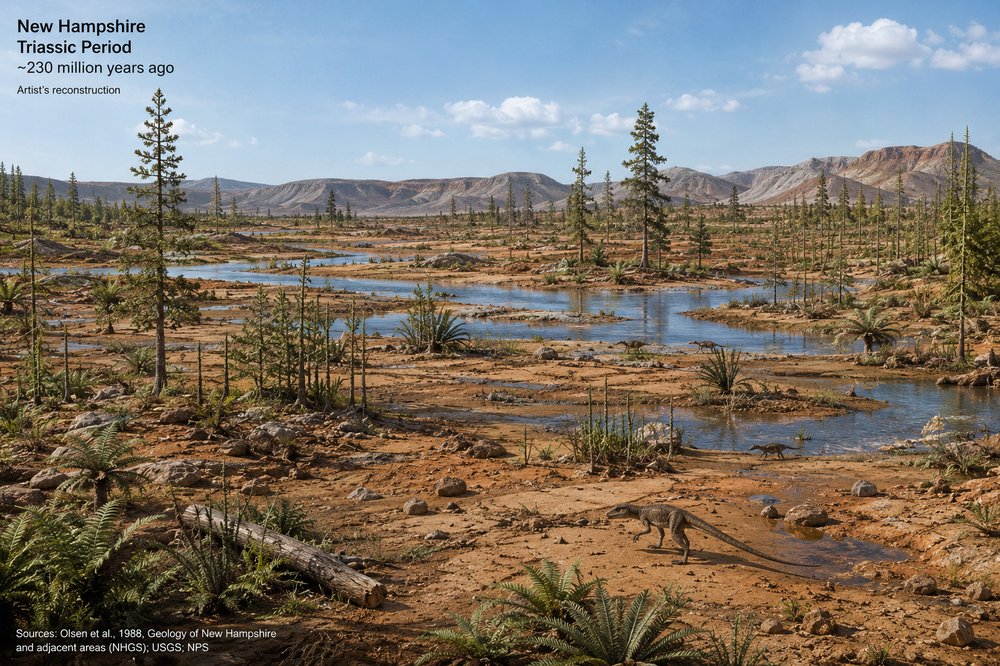
During the Triassic Period, about 252 to 201 million years ago, New Hampshire was part of the supercontinent Pangaea. The Atlantic Ocean had not yet formed, and the region sat much closer to the equator than it does today. Its climate was generally warmer and more seasonal, and the landscape probably included rocky uplands, river valleys, conifer-like plants, ferns, and other ancient vegetation.
Near the end of the Triassic, Pangaea began to split apart. The crust of eastern North America stretched and fractured, creating rift valleys and allowing magma to rise underground. This activity helped begin the long process that eventually opened the Atlantic Ocean. New Hampshire contains Mesozoic igneous rocks connected to this broader period of crustal movement, although much of the well-known White Mountain magmatism occurred slightly later, during the Jurassic and Cretaceous periods.
Early dinosaurs and other reptiles probably lived in the broader New England region, but New Hampshire has not produced confirmed dinosaur bones or trackways. Nearby parts of the Connecticut River Valley preserve Triassic and early Jurassic sandstone containing famous dinosaur footprints, showing that dinosaurs definitely roamed this general area. New Hampshire's own Triassic surface rocks were largely removed by millions of years of erosion and later glacial activity, which helps explain why direct fossil evidence is so scarce.
New Hampshire may not have given up its dinosaur fossils — but your basement, garage, or attic have probably been hiding a few relics of their own. Let's make that junk extinct too.
New Hampshire may be light on dinosaur evidence, but these nearby states more than make up for it. A few real, visitable spots for the next family road trip.
Widely considered the best public fossil-hunting site on the East Coast. Wade the shallow stream and screen the gravel bars for 75-million-year-old shark teeth, ammonites, and the occasional hadrosaur bone fragment.
Site guide: fossilguy.com →Cretaceous fossil beds along Poricy Brook. Public collecting is allowed, capped at five fossils per visit.
poricypark.org →A dinosaur trackway from Towaco, NJ, plus a nearly complete mastodon skeleton. Free admission, guided tours available.
geologymuseum.rutgers.edu →Over 2,600 early Jurassic footprints preserved under a geodesic dome, on the very lake bed where they were discovered in 1966. A seasonal track-casting area lets visitors make their own take-home cast.
dinosaurstatepark.org →The newly renovated Burke Hall of Dinosaurs, home to the first Brontosaurus specimen ever discovered. Admission is free.
peabody.yale.edu →Life-size dinosaur models throughout the "Extreme Dinosaurs" exhibit, including a 47-foot T. rex in the outdoor dino paddock.
ctsciencecenter.org →A free, 8-acre riverside site with 800+ early Jurassic tracks exposed right on the rock slabs. Open sunrise to sunset, April through November. Look, touch — no casting, to protect the prints.
thetrustees.org →Home to the Hitchcock Ichnology Collection — over 1,100 slabs of Connecticut River Valley dinosaur tracks, one of the great trace-fossil collections anywhere in the world.
amherst.edu/museums/naturalhistory →Hours, admission, and special exhibits change seasonally — check each museum's site before you go.
Most public sites need less equipment than you'd think — but a few basics make the difference between finding something and walking home empty-handed.
For carefully splitting sedimentary rock along its natural bedding planes.
Sift stream gravel at creek sites like Big Brook or Poricy Park to catch small teeth and shells.
Rock chips fly when you're splitting stone — always protect your eyes.
Protects your hands from sharp rock edges and streambed debris.
Handy for checking small finds like shark teeth for detail before you keep them.
Small labeled containers keep finds from getting jumbled, chipped, or lost.
Most public sites — Big Brook and Poricy Park included — mean wading in shallow streams.
Helps you tell a real fossil from an ordinary rock before you get too excited.
Rules vary by site — Big Brook Preserve allows hand-tool streambed collecting but bans bank-digging, Poricy Park caps collecting at 5 fossils per visit, and Dinosaur State Park and Dinosaur Footprints Reservation are look-and-touch only (no digging or casting outside their designated areas). Check the site's own rules before you bring anything sharp.
The two most popular public fossil-hunting sites within a day's drive.